*This report is split into two posts due to character limits
Post 1/2
Introduction
This document represents the first quarterly report we committed to presenting to the DAO as part of our role in the Velora Governance Task Force, with the goal of providing insight into the DAO’s overall state and participation.
To that end, we will begin by analyzing the starting point — the condition of the DAO prior to our full involvement in October 2024. We will then review an intermediate stage, from October 2024 to March 2025, during which we acted as delegates, and finally examine the period from April 2025 to the present, in our role as Governance Task Force. For each stage, we will highlight the evolution, activity levels, participation, and overall condition of the DAO.
In our comprehensive report titled “Driving Protocol Success through Optimized Governance”, published on November 10, 2024, we stated the following: ‘DAOs face significant challenges, such as lack of participation, apathy among token holders, organizational difficulties, and the tendency to become slow and inefficient structures, and ParaSwapDAO is no exception’. In that report, we conducted a detailed analysis of several DAO metrics, all of which revealed that the then-ParaSwapDAO was going through a period of very low activity—almost stagnation—with very few proposals or debates. Nearly all participation efforts were being driven by the Foundation and Laita, who were behind almost every initiative.
Let’s now look at concrete numbers and how they’ve evolved since then:
1.- Proposals
This metric is particularly relevant to us, as proposals are the lifeblood of a DAO. They reflect that community members are actively submitting governance initiatives, engaging in discussion, and ultimately putting them to a vote. This is the purest expression of a DAO: generating ideas, debating them, and collectively deciding on actions that will impact the DAO and/or the protocol.
Since the inception of the DAO until November 2024, a total of 68 proposals have been voted on over approximately three years, averaging 1.8 proposals per month, consistent with the scale of ParaSwap:
- 2021 (November and December): 11 proposals - Average of 5.5 proposals per month
- 2022: 22 proposals - Average of 2 proposals per month
- 2023: 29 proposals (the year with the highest activity) - Average of 2.4 proposals per month
- 2024 (until November): 6 proposals - Average of 0.6 proposals per month
- From November 2024 to March 2025: 10 proposals - 2 proposals per month
- From April 2025 to June 2026: 14 proposals - 4,66 proposals per month

Source: VeloraDAO governance dashboard developed by SEEDGov.
These metrics show that since our involvement in the DAO, during the period from November 2024 to March 2025—with an average of 2 proposals per month—the DAO quickly reversed the near-paralysis it had experienced during the earlier part of 2024, which averaged only 0.6 proposals per month. This shift brought proposal activity levels closer to those of 2023, which had been the DAO’s most active year to date, averaging 2.4 proposals per month.
Furthermore, since officially assuming our role as the Governance Task Force (GTF) in April 2025—and although we are still measuring a relatively short three-month period—these metrics have not only stabilized and solidified but have also shown meaningful growth, reaching an average of 4,66 proposals per month. This indicates that the DAO has firmly moved beyond the stagnation of the first three quarters of 2024 and is now experiencing a period of active and healthy governance.
2.- Voters
The number of individual voters (addresses) has steadily declined since the inception of the DAO:
- First 10 votes: Average of 708 addresses
- From November 2023 to October 2024: Average of 160 addresses
- From November 2024 to March 2025: Average of 67 addresses
- From April 2025 to June 2026: Average of 57 addresses

Source: VeloraDAO governance dashboard developed by SEEDGov.
These data reflect a common trend observed across many DAOs: a strong initial wave of participation from retail users who either purchased or received governance tokens via airdrops and were actively engaged in the early stages. However, over time, there is a sharp decline in the number of active governance addresses. This drop is driven by various factors, such as retail holder apathy, increasing token concentration in the hands of large investors, and the impact of token vesting unlocks, which typically benefit seed investors or early team members.
Despite this trend, since the approval of PIP-53 in October 2024, the number of active voting addresses has remained relatively stable, fluctuating between 50 and 88. This suggests that the previous decline has plateaued, giving way to a smaller yet more consistent and engaged participant base.
Combined with the data we later present on the concentration of voting power, this highlights a shift in the DAO’s participation model—from a highly atomized structure of direct involvement by many tokenholders with low voting power, to one where professional delegates now play a central role.
Many token holders have chosen either to step back from direct involvement or to delegate their voting power to experienced and dedicated delegates. While direct participation from token holders is positive and desirable, it has become increasingly rare in practice. In contrast, professional delegates have proven to offer a more balanced and stable governance approach, often bringing technical expertise, consistent involvement, and a long-term perspective—unlike individual holders who may be driven by short-term incentives.
This shift has been instrumental to the growth of VeloraDAO, enabled by the successful launch of the Delegate Program Trial Period and later the Delegate Incentive Program, which provided the foundation for a more professional and reliable delegation system. The effectiveness of this model is further reflected in the following section, where we analyze the sustained growth of voting power in the DAO’s decision-making process.
3.- VP (Voting Power - PSP Voter)
The amount of tokens used for voting has increased over time. Since the implementation of the PSP 2.0 system in February 2023:
- First 10 DAO votes: Average voting power of nearly 76 million PSP
- From November 2023 to October 2024: Average voting power of nearly 139 million PSP (83% increase)
- From November 2024 to March 2025: Average voting power of nearly 325 million PSP (134% increase)
- From April 2025 to June 2026: Average voting power of nearly 394 (21% increase)

Source: VeloraDAO governance dashboard developed by SEEDGov.
Voting PSP has shown a consistent upward trend since the DAO’s inception, with a noticeable dip in participation during Q1 2024 that was subsequently reversed. Since November 2024, PSP participation has recovered significantly, growing by over 130%, with further growth by over and additional 21% observed since we assumed our role as GTF in April 2025.
A closer look at the chart above, combined with that of Proposals Over Timeagregar marcador titulo anterior, not only confirms this exponential growth but also reveals four distinct phases in the DAO’s voting PSP participation.
-
Phase 1 (November 2021 – February 2023):
This early stage was marked by very low PSP participation, but high numbers of individual voters. This suggests that many retail users, each holding small amounts of tokens, were actively involved in governance, though total voting PSP remained low.
-
Phase 2 (February 2023 – January 2024):
A period of steady growth in voting PSP, increasing from around 55 million to 251 million. Combined with an increase in governance proposals, this indicates a DAO that was expanding in both activity and engagement.
-
Phase 3 (January 2024 – October 2024):
This phase reflects the previously discussed stagnation period. Both proposal activity and voting PSP sharply declined. This decline was not coincidental—the DAO’s inactivity led to growing apathy among token holders, creating a vicious cycle of disengagement.
-
Phase 4 (November 2024 – Present):
In this most recent phase, the DAO has experienced a strong resurgence, with record highs in both proposal activity and voting PSP. The prior vicious cycle has been replaced by a virtuous one: more proposals, deeper debate, and significantly higher PSP engagement in decision-making processes.
Likewise, from the observation of the VP per Proposal graph, it can be seen that the participating PSP shows an upward trend, from an average of 325M PSP in the period November 2024/March 2025, to an average of 394M PSP in the period April 2025/June 2025.
The observation of this graph also shows that the previous ceiling of PSP token participation in votes during 2024 —300 million PSP, which was a historical record until November of that year— has now become the floor of participation. Currently, a significantly higher presence of voting PSP can be observed, which is highly positive for the overall health of the DAO for multiple reasons:
- Greater legitimacy and representativeness in decision-making.
- Greater security and resilience against potential capture attempts or governance attacks.
- Greater accountability, control and alignment of interests over the proposals debated and voted on.
- Fostering engagement and a sense of community.
- Community maturation key for the long-term stability and evolution of a DAO.
- Attraction of new stakeholders that an increase new opportunities.
In short, the new floor of PSP participation not only improves the quality and legitimacy of decision-making, but also represents an institutional shield and a clear sign of the resilience and maturity the DAO has achieved.
4.- Concentration of Voting Power
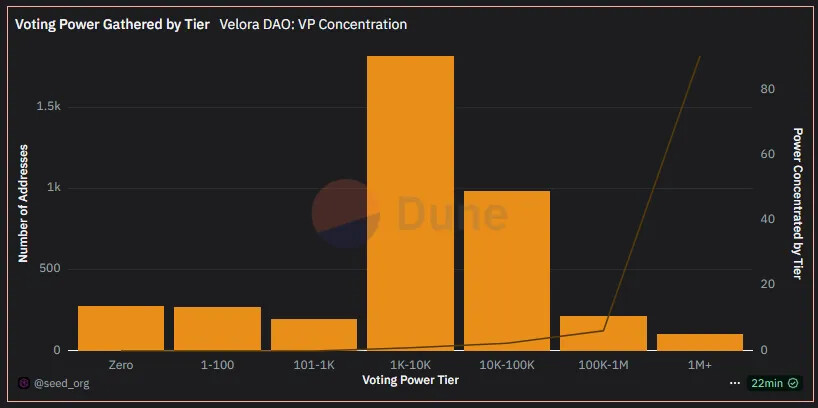
This indicates that voting power has become concentrated among fewer individuals:
Status in November 2024:
- 271 voters without voting power
- 1,831 voters with voting power between 1,001 and 10,000 PSP
- 977 voters between 10,001 and 100,000 PSP
- 65 voters with more than 1 million PSP, representing 83% of the total voting power of the DAO.

Chart taken from our ‘**Driving Protocol Success through Optimized Governance’ post*
Current status:
- 277 voters without voting power
- 1,820 voters with voting power between 1,001 and 10,000 PSP
- 986 voters between 10,001 and 100,000 PSP
- 103 voters with more than 1 million PSP, representing 83% of the total voting power of the DAO.
Source: VeloraDAO governance dashboard developed by SEEDGov.
The voting power in the 0 to 100,000 PSP range has remained relatively stable. However, there has been a significant shift in the concentration of voting power among wallets holding over 1 million PSP: from 65 voters in November 2024 to 103 voters today—an increase of nearly 60%.
This change clearly reflects the positive impact and success of the Delegate Program, and shows a much healthier governance structure compared to the past. Previously, the DAO had lower overall PSP participation, meaning those 65 large, anonymous wallets effectively held control over governance. Today, by contrast, the 20 recognized delegates collectively hold 277 million PSP in voting power, a significant number, which is distributed among known, accountable actors with clear track records.
This means that today:
- Much more PSP is actively voting, which dilutes the relative influence of large holders.
- More wallets hold high VP, but that power is now spread across a broader base.
- There are 16 delegates with 1M+ PSP each, all of them publicly identified, with visible voting records and clear accountability.
- DAO security and resilience have improved, as the threshold for governance capture has increased.
- Dynamic accountability: If a delegate misaligns with the DAO or protocol, tokenholders can revoke their delegated VP.
In short, we’ve moved from a small set of 65 anonymous, high-voting-power wallets to a more decentralized, professionalized, and transparent voting structure. This reinforces the DAO’s robustness and its capacity for long-term sustainability.
5.- Forum Activity
An equally important indicator of the DAO’s progress is the noticeable increase in both the activity and quality of discussions on the governance forum. While this may seem like a subjective observation, it becomes evident when reviewing current threads: there is a clear rise not only in the number of contributions but also in their depth and constructiveness.
We now see more thoughtful and well-rounded conversations, with extensive constructive feedback and actionable suggestions that often lead to revised proposals. These improved versions tend to reach Snapshot with greater clarity, robustness, and broader consensus than the initial drafts.
Regarding the substance and scope of the proposals recently debated and voted on, the DAO has achieved meaningful advancements, such as:
- The approval of a stronger and more coherent PIP lifecycle framework that improves decision-making processes.
- The automation of fee and gas refund calculations and distributions, previously done manually.
- The creation of the Governance Task Force (GTF), functioning as a governance facilitator.
- The institutionalisation of the delegate role, with over 20 delegates publicly introduced on the forum —most of whom are actively participating.
- The establishment of the Velora Growth Committee (VGC).
- The increase in the quorum required for proposals to pass.
- The normalization of regular community calls to foster open discussion.
Altogether, these changes reflect a DAO that is entering a more mature and active phase, not only in terms of proposal volume but also in its quality and sophistication of governance discussion.
6.- PSP staking
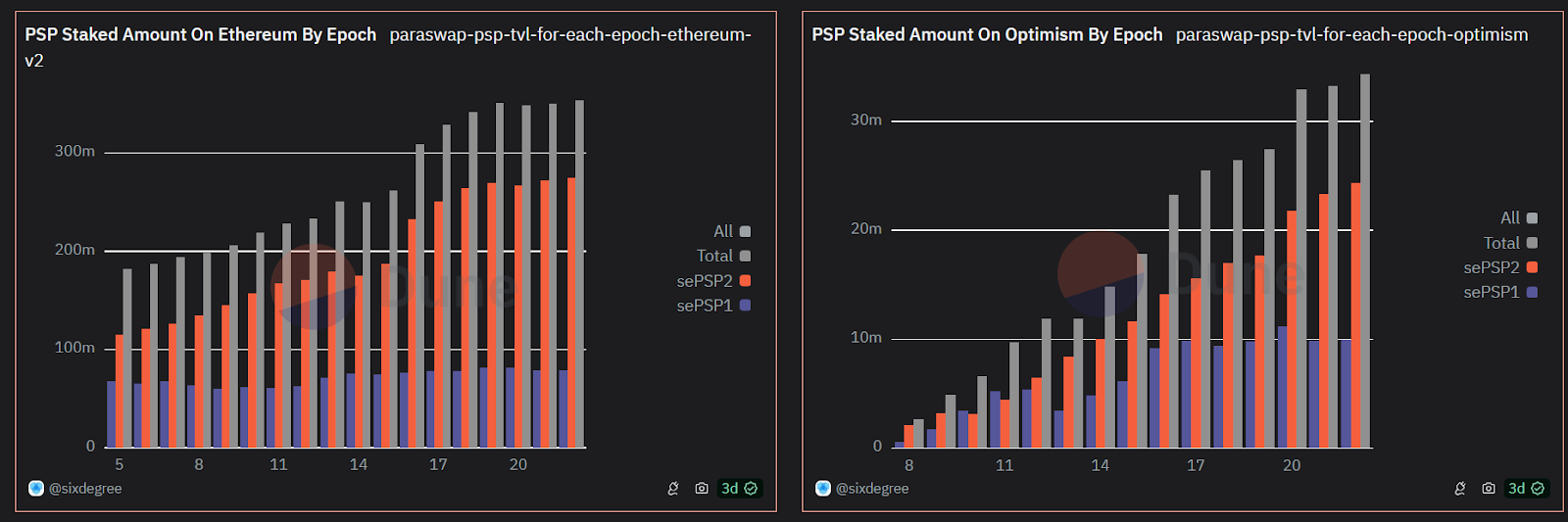
In November 2024 there were 388M total PSPs in staking, distributed 353.6M on Ethereum and 34.3M on Optimism. A steady increase of PSP in staking was observed at that time in both Ethereum and Optimism.
Source: ParaSwap PSP 2.0 General Metrics.
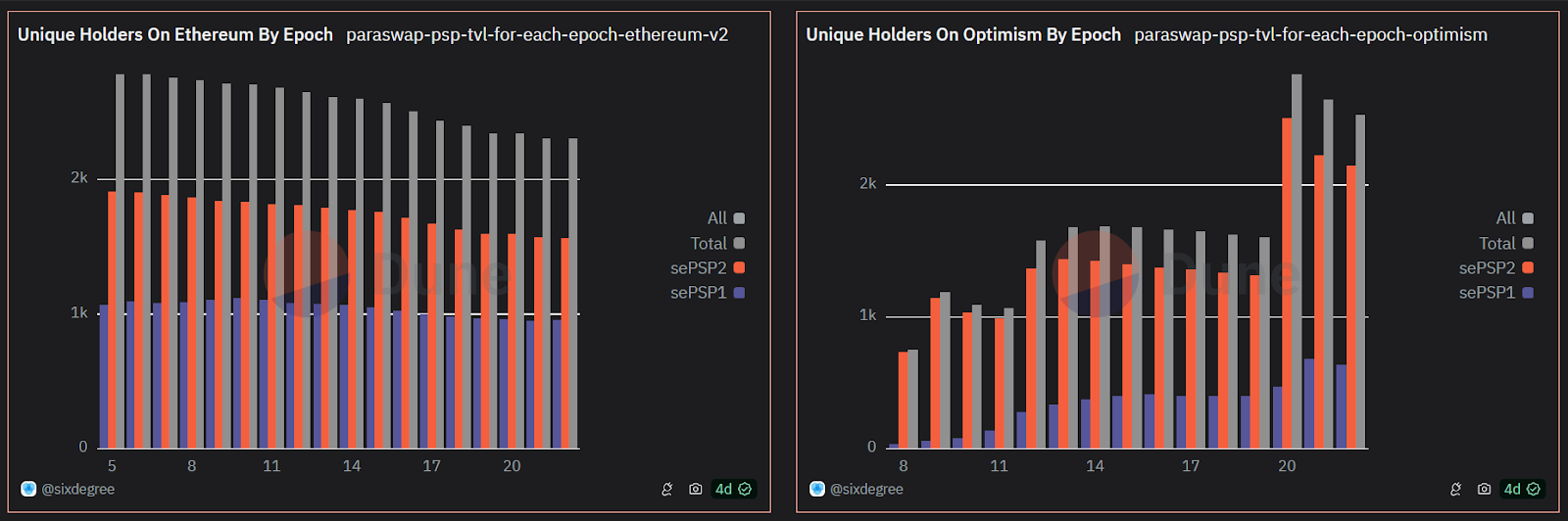
The total unique stakers at that time was 4,836, and also showed a steady increase, which, while decreasing slightly in Ethereum, increases significantly in Optimism, with the total number of unique holders increasing over time. On Ethereum, in Epoch 22,unique holders were 2,303, while on Optimism were 2,533, an increase of 335%.
At present, six months later, during Epoch 32, it can be observed that the total PSP in staking amounts to 442.2M, distributed as 396.4M on Ethereum and 45.7M on Optimism, which shows a strong increase across all aspects.
The total amount of PSP in staking over these six months increased from 388M to 442.2M, that is, a 14% increase. If we break it down by chains, we see that on Ethereum it rose from 353.6M to 396.4M —a 12% increase— and on Optimism from 34.3M to 45.7M, representing an increase of nearly 33%.

Source: ParaSwap PSP 2.0 General Metrics
As for unique stakers, six months after the previously analyzed data, the total number of unique PSP stakers is 4,160, distributed as 2,069 on Ethereum and 2,071 on Optimism.
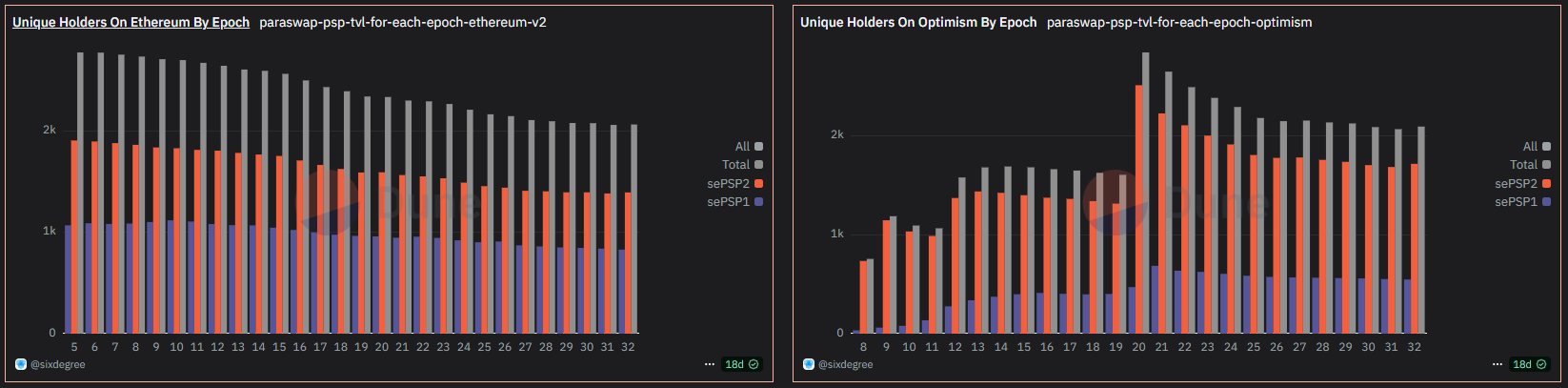
This means that the total number of unique stakers decreased from 4,836 to 4,160, a 14% drop. On Ethereum, the number went from 2,303 to 2,069, a decrease of 10%, while on Optimism it dropped from 2,533 to 2,071, representing an 18% decrease.
The combination of these figures —a 14% decrease in the number of unique stakers over recent months, along with a 14% increase in total PSP staked— confirms a broader trend observed across various protocol metrics: a decline in retail holder and voter participation, coupled with an increased concentration of PSP among fewer holders, who have also raised their level of governance engagement.
This is a warning sign that should not be overlooked. The DAO and the protocol must actively address this trend by developing strategies to reignite interest among retail users, encouraging them to acquire PSP, stake their tokens, and participate in governance —whether directly or by delegating their voting power. The ‘Road to Velora’ campaign, developed by Laita, is specifically designed to address one of these challenges, since a core element of the campaign aimed at boosting engagement and encouraging users to earn points is the promotion of PSP staking in the sePSP2 module. The first metrics reported by Laita already shows a strong progress and positive impact in this aspect, it will be very interesting to analyze the final metrics once the campaign concludes.
7.- DAO Structure
In November 2024, the DAO had a minimal structure:
- GovCo was the only existing structure, centralized in nature, and had a relatively minor role: overseeing the Ethereum Fee Claimer wallet and executing the fee distribution and gas refund, as well as approving emergency proposals for PIP qualification.
- The calculations for fee distribution and gas refunds were done manually, with the responsibility falling on the ParaSwap/Velora team. This not only added to their workload but also carried the latent risk of human error due to the manual nature of the process.
- There were no other structures in place.
- While Snapshot was enabled, there were no delegates formally introduced on the forum, nor were there any participating or reporting on their activity.
- The DAO community was limited to the Paraswap team at the time and a few individual contributors acting without coordination.
By March 2024, the reality of the DAO had changed significantly:
- 18 formally introduced delegates on the Delegation section of the forum, 17 of whom had varying degrees of considerable activity and only 1 inactive. 12 joined during the successful Delegate Program Trial Period, and the remaining 5 joined in March during the next phase of the DIP. Of the 18 delegates, 9 were active participants in the DIP.
- The Cycle 1 of the Delegate Incentive Program had just been approved and launched after a successful test.
- A DIP Program Manager was formalized, responsible for the program’s operational tasks and for providing the community with public reports on its performance.
- Approval of PIP-55 to develop an automated fee and gas refund distribution mechanism.
- The creation of the ParaSwap Growth Working Group (PGWG) as a temporary DAO structure.
From April to June 2025, even within a short period, this trend toward greater maturity and structuring of the DAO deepened:
- 2 new delegates joined, bringing the total to 20 formally presented delegates on the forum, 19 of them with varying levels of participation and only 1 inactive. 14 of them are currently participating in the DIP.
- Creation of the Velora Growth Committee (VGC) and the launch of its 6-month first season as a structure with the potential to become a permanent DAO body, contingent on the success and impact of the experience. The committee has 5 participating members, along with representation from Laita.
- Formation of the Governance Task Force, tasked with facilitation, coordination, and overall DAO management.
- Formalization of Laita as DAO service provider to perform marketing facilitation, infrastructure and developer support tasks. Presentation in the forum of updates on its activities, increasing transparency in the DAO.
- Successful automation of the fee and gas refund calculation and distribution mechanism.
- Deprecation of GovCo and decentralization of both multisig management/signing responsibilities and emergency proposal PIP qualification—now handled by various DAO contributors through a public, structured, and predictable selection and onboarding process.


