PIP-72 - Liquidity Funding for Futarchy Experimentation in Velora Governance

PIP-72 - Liquidity Funding for Futarchy Experimentation in Velora Governance

Co-authors: Velora Growth Committee & Futarchy.fi

Abstract

If approved, this proposal will:
• Launch a non-binding futarchy pilot with Futarchy.fi to test futarchy evaluations (YES/NO conditional markets) in Velora governance.
• Enable the Velora Growth Committee to create markets forecasting VLR price outcomes of proposals and milestones.
• Deploy $50,000 in DAO liquidity (25,000 VLR + 25,000 sDAI) into Uniswap V3; funds return to the treasury after the trial.
• Require no operational budget, only temporary liquidity, with minimal impermanent loss (≤ $1.5k for 50% $VLR price increase).
• Explore a potential Velora integration in Futarchy.fi, opening the door for deeper protocol partnerships.
• Establish an advisory evaluation mechanism: after a 7-day window, compute an impact estimate (YES–NO TWAP); recommend For if ≥ +1%, Against if ≤ −1%, and Neutral otherwise.

Goals & Review

With the Road to Velora campaign progressing and the $VLR migration in progress, this is a timely moment to test new governance tools.

The pilot is non-binding: futarchy evaluations will not trigger on-chain actions, but will provide signals on proposals and milestones that may help delegates and contributors gauge sentiment, timing, or traction.

If successful, this experiment could:
• Encourage richer discussion.
• Validate futarchy as a governance signal.
• Open the door to formal integrations of futarchy-style tools into Velora governance.

See: From Signals to Systems.

Pilot Objectives
• Test a new governance tool
• Run a low-risk futarchy experiment that generates decision-making signals without altering existing DAO processes.
• Explore infrastructure integration
• Showcase Futarchy.fi and Seer One’s interest in integrating Velora routing, and test how this could support their operational needs.
• Boost community engagement
• Highlight Velora’s rebrand and token migration, while encouraging wider participation.

Scope & Means

Liquidity Deployment

  • The pilot will deploy $50,000 USD in liquidity (25,000 USD in VLR and 25,000 USD in stables) using Uniswap v3 on Ethereum Mainnet under the following parameters:
    Contract: Uniswap v3 (full-range) on Ethereum Mainnet, fee tier 0.01%.
    Concentration: By default, liquidity is deployed in a wide (“baseline”) range. Optionally, the multisig may deploy up to 5× concentrated liquidity (narrower tick ranges) per market to improve price discovery and slippage near the current price.
    Full-range Liquidity: At least 20% of the capital allocated to each pool will be deployed in a full-range position to ensure price discovery during volatility.
    Arbitrage: Up to 5% of the capital may be allocated to arbitrage contracts, which will arbitrage between spot and conditional markets. Arbitrage profits belong to the DAO and may be reused as liquidity.
    Rebalancing: For concentrated liquidity positions, rebalancing may be performed at most once per 24h.

Market Setup

Markets will be organized around two primary categories: Milestone-Based Markets and Governance Proposal Markets. As of now, token price is the one core metric that can be considered within Futarchy.fi. In the future, other metrics may become available, but we believe token price represents a good starting point for evaluating the expected impact of major events.

Milestone-Based Markets
These markets explore how events like token migrations, integrations, or campaign outcomes might affect protocol metrics. Examples include:
• What will VLR’s price be if Velora’s average monthly trading volume exceeds $X million during Q4 2025?
→ Shows whether traders think more trading activity will actually push VLR’s price up.
• What will VLR’s price be if Velora’s cumulative protocol revenue surpasses $Y during Q4 2025?
→ Checks if the market expects higher revenue to have a direct effect on VLR’s price.

Other DAOs are already testing similar designs. For example:
• What will be the impact on GNO price if Circle deploys native USDC on Gnosis Chain on/or before December 31, 2025? - See market

Governance Proposal Markets
These markets estimate the anticipated effect of governance proposals on one or more protocol metrics.
• Example: What will be the impact on $GNO price if GIP128 is approved? - See market
• In Velora, a relevant case is PIP-59 (Proposal for Returning 40.203 wETH to Bybit), which prompted a strong debate. A futarchy market tied to VLR price or protocol volume could have offered additional insight for tokenholders focused on outcomes beyond sentiment or principle, especially in controversial decisions.

Evaluation Rule

Each futarchy evaluation will run for 7 days, during which liquidity remains active in the markets. To guarantee reliable price signals, at least 20% of every pool will always be kept in full-range positions, ensuring continuous TWAP calculations even during volatility.

At the end of the evaluation window, the estimated impact is calculated as the difference between the TWAP of the YES market and the TWAP of the NO market. Based on this outcome, the pilot will issue an advisory recommendation:
• For if the impact (YES − NO) ≥ +1%
• Against if the impact ≤ −1%
• Neutral otherwise

To avoid spreading liquidity too thin, the pilot will evaluate only one governance proposal at a time, alongside at most three milestone markets in parallel.

Multisig
• Create 2-of-3 multisig (2 DAO Members (GTF + VGC member or Laita) + Futarchy.fi). A member of futarchy.fi is required for organizational purposes.
• Powers: deploy liquidity, rebalance (≤1/day), allocate ≤5% to arbitrage.
• All activity displayed on the DAO forum.

Community Participation
Open Access: All markets will be open to anyone: traders, liquidity providers, and curious DAO members with no technical or eligibility barriers.
Transparent Data: All trading, pricing, and market resolution data will be publicly available and on-chain.
Education & Onboarding:

  • VGC & Futarchy.fi will co-host a community call to introduce the pilot and explain how each futarchy evaluation works.
  • The VGC will produce and publish educational content explaining how futarchy works, what the pilot aims to test, and how participants can get involved.

Implementation Overview

Time of Implementation
• Immediate after proposal passes.

Duration
• 6-month trial period.
• DAO may terminate early via Snapshot vote.

Steps

  1. Create multisig.
  2. Transfer VLR and/or DAO assets from the main treasury to multisig (or equivalent VLR/wETH swapped to stables if unavailable).
  3. Launch markets (proposals & milestones).
  4. Manage Uniswap v3 positions per the Liquidity Mandate (≥20% full-range, ≤5× concentration, ≤1 rebalance/day).
  5. Resolve markets via Reality.eth & Kleros Oracle.
  6. Publish post-pilot review including participation, volume, impermanent loss and accuracy of Futarchy signals.

Post-Pilot Review
• VGC & Futarchy.fi to deliver assessment covering:
• Outcomes.
• Participation.
• Insights for next steps.

Budget & Cost

This proposal does not request an operational budget, it only asks the DAO to provide liquidity to seed the pilot markets.
• Liquidity Provision: $50,000 (25,000 VLR + 25,000 sDAI).

The DAO’s risk exposure from liquidity provision is minimal. Based on simulations with $25,000 VLR + $25,000 sDAI, impermanent loss is <= 2% of deployed liquidity under a 50% price move, and lower for smaller moves.

Impermanent Loss Analysis (Full-Range Liquidity)

Token Price Change IL (USD) % of Liquidity
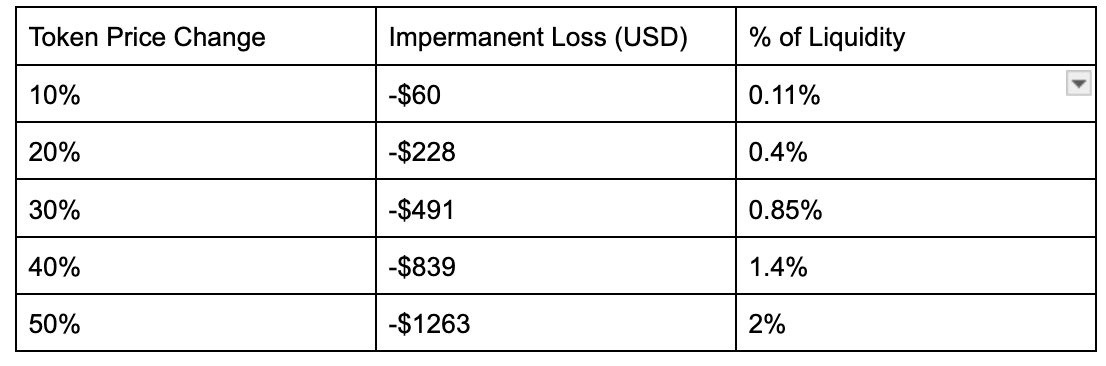
Even in the unlikely event of a 50% VLR price swing during the pilot, the DAO’s maximum IL exposure would be less than $1.5k for a full-range liquidity position For more moderate movements (10–30%), IL is negligible.

In other words: the DAO’s cost exposure is small, predictable, and primarily a function of VLR price movement during each market.

For concentrated liquidity (up to 5× narrower), impermanent loss can be higher, but rebalancing is capped at once per 24h. At least 20% of liquidity is always kept full-range, which ensures continuous pricing and limits downside exposure.

Why Futarchy.fi?
Futarchy.fi is the first Ethereum-native platform designed specifically for running futarchy evaluations with conditional markets, putting Robin Hanson’s idea of “vote on values, bet on beliefs” into practice. Built on the battle-tested Gnosis Conditional Token Framework, the platform uses conditional outcome tokens and resolves markets through Reality.eth and Kleros, a decentralized oracle and arbitration stack.
The Futarchy.fi platform is already being tested by different DAOs, for VeloraDAO, it offers a clear and flexible way to experiment with conditional-market-driven governance.

Opportunity for Velora
Foster Opportunity for Velora Integration
Futarchy.fi could benefit from an intent-based protocol like Velora, to optimize the routing of orders and swaps. A first step would be a joint exploration with the VGC if this pilot is approved.
In the long run, such an integration would allow Velora DAO to use the same liquidity provided for futarchy markets as regular VLR liquidity. In practice, this means that if someone swaps between VLR and sDAI, their trade could be routed through the YES VLR and NO VLR pools, so the liquidity serves both futarchy evaluations (YES/NO conditional markets) and everyday trading at the same time.
This would enable the same LP to be used for two purposes:

  1. Futarchy Markets
  2. Regular Liquidity between VLR and sDAI

Risks & Mitigations

• Financial Risk: limited to impermanent loss.
• Operational Risk: multisig ensures controlled deployment; rules cap rebalancing and IL exposure.
• Adoption Risk: pilot is advisory, non-binding; no protocol actions depend on it.

Voting Options

• Option A: Approve $50,000 liquidity (25,000 USD in VLR + 25,000 sDAI) for 6-month futarchy pilot.
• Option B: Do not provide liquidity.
• Option C: Abstain.

Useful links

5 Likes

Happy to co-author this proposal on behalf of Futarchy Labs, and would be pleased to discuss the proposal further with any delegates and members of the Velora community.

2 Likes

Thanks for surfacing this. I am familiar with the team at futarchy.fi and very interested in seeing how these kinds of systems might be able to augment the work we are doing. A few questions:

  • Are there any current examples from other DAOs where futarchy markets provided unique insights that improved governance decisions?
  • Could incorporating other metrics beyond price, or ways to make the tool useful for our regular operational decisions?
  • Would it make sense to validate the concept with a smaller initial experiment focusing on a lesser number of proposals? This could help us understand participation levels and signal quality before committing the full amount.

Thanks again for being proactive in exploring new approaches!

4 Likes

Thank you for presenting this proposal! As outlined in my delegate statement, I work with Kleros, the entity providing oracle resolution for the Seer One Prediction Market and Futarchy.fi. Given my involvement in helping to craft this proposal alongside the Futarchy.fi team and the VGC committee, I acknowledge a COI and I have chosen that I will vote “Abstain” to help reach out the Quorum (@SeedGov, if this option can be added ;))

While my bias is evident, I firmly believe prediction marketsare not only about gambling, but about offering valuable insights to guide critical decision-making. Historically, financial primitives once dismissed as mere gambling—such as options and futures—have become indispensable tools to provide high quality information, more infos here.

This proposal presents an excellent opportunity for the Velora DAO to experiment with prediction market information for governance purposes at almost no cost (only small and limited IL).

To answer your first question @Sov at Kleros DAO, we have successfully integrated Futarchy markets for several proposals, yielding actionable data for voters. For instance, the proposal referenced in this tweet, highlights a non-consensual vote where the token holder community was split. However, the accompanying Futarchy market indicated a bullish outlook for the PNK token, with a potential positive price impact. This is valuable additional information that could be used by a voter that isn’t sure what to vote for and wants to maximize the value of its holdings.

On the opposite, you can see another proposal that got rejected by the Kleros DAO where Futarchy markets forecasted a negative impact on PNK value, this information was even chosen as a rationale by some voters.

For your second point, we discussed this internally, and while incorporating additional metrics beyond price may be technically feasible in the future, the choice was made to only focus on price for this initial proposal to avoid extra complexity.

Regarding your final point, futarchy markets require sufficient liquidity to function effectively. As noted in this Kleros Forum comment, a liquidity level of $100k was selected for Kleros DAO. To keep the LP requirement as low as possible, we plan to utilize concentrated liquidity for the $50k amount required to Velora DAO, going significantly lower than this would likely be challenging. Also the period of 6 months is here to guarantee there is enough time for interesting milestones or proposals to happen to experiment with Futarchy markets. The risk of going for a shorter period would be to lack data points and being unable to assess the value bring by the experiment.

@kas feel free to add anything or correct me if needed, happy to answer any other questions !

4 Likes

The proposal has been edited and the option to abstain has been added:

Thanks for the detailed responses @0xAlex

I appreciate you bringing this forward - these mechanisms are still very experimental, and I think it’s valuable for Velora to explore new approaches.

I’m supportive of running this experiment. My main suggestion would be to clearly define what success looks like upfront - whether that’s participation levels, volume thresholds, or correlation between market signals and governance outcomes. This way we can properly evaluate whether to continue or expand after the pilot.

Looking forward to seeing how this develops. Innovation in governance is important, and controlled experiments like this are how we learn what works.

3 Likes

Thanks for bringing this forward. I think this kind of experimentation is very valuable to push VeloraDAO governance forward, and futarchy can indeed open interesting doors for decision-making.

At the same time, I’d encourage us to think not only about funding liquidity, but also about how we can capture learnings from the experiment and translate them back into DAO processes. For example, setting clear metrics of success (beyond liquidity depth) and documenting the outcomes would help the community assess whether futarchy adds value in practice and how it could be scaled.

This way, the initiative is not just a one-off test, but becomes part of building institutional memory and governance innovation inside the DAO.

2 Likes

I think this is a great idea.

Velora is a nimble DAO that can afford to experiment, and futarchy is the type of innovation that attracts attention. Being one of the first DAOs to study it will put Velora on the map, with other projects watching and learning from the results.

It could also benefit token growth. If markets consistently show that good governance decisions push the token higher, Velora becomes one of the first DAOs where governance is directly tied to value creation.

That’s a powerful narrative both for the community and the wider DeFi ecosystem.

3 Likes

Introducing a futarchy pilot for Velora governance where conditional markets would forecast the impact of different proposals and milestones on the $VLR token price would be very intersesting and something we think is worth exploring. We like that the pilot is explicitly non-binding, meaning it won’t automatically change DAO decisions but instead provide advisory signals that delegates can weigh alongside traditional sentiment and debate. Deploying $50,000 in liquidity (half in $VLR, half in stablecoins) on Uniswap v3, with careful guardrails around concentration, rebalancing, and arbitrage, with funds expected to return to the treasury after the six-month trial, will limit risk to a small amount of impermanent loss.

What’s particularly interesting here is the dual framing of futarchy both as an educational tool and as a decision-support mechanism. On the one hand, it lowers the barrier for community members to engage with governance through prediction markets, making discussions more outcome-focused rather than purely rhetorical. On the other hand, it tests whether token price forecasts can actually enrich governance—helping filter proposals not just by principle, but by anticipated impact. Overall, the program feels pragmatic: only one proposal market at a time plus a few milestone markets, transparent data on-chain, and clear evaluation rules (≥ +1% “For,” ≤ −1% “Against,” otherwise neutral).

This measured rollout suggests the goal isn’t to overhaul governance overnight but to build confidence in futarchy’s usefulness. If the trial shows that markets provide meaningful foresight, Velora could position itself at the frontier of governance innovation, while if not, the cost of the experiment remains relatively small.

We’d be curious to hear what others think about using token price as the initial metric—do people feel it’s a strong enough proxy for protocol health, or should the DAO already be considering alternative measures like revenue or volume in future iterations? Overall, in support of the trial.

3 Likes

We are generally supportive of this proposal. Prediction markets, and the futarchy approach that builds on them, hold many possibilities, and being able to experiment at an early stage with relatively low cost is valuable. For Velora, this is an important step toward building a more mature and higher-quality DAO governance process.

As @Sov pointed out, it remains uncertain how much practical impact this will have, and we recognize this is still exploratory.

The examples shared by @0xAlex show that there can be meaningful signals, and we agree that it is reasonable to treat this as an experiment rather than requiring overly strict standards at this stage. We also align with @0xAlex’s view below that reducing the scope or liquidity further would make the experiment less effective, since only certain types of proposals are well suited to futarchy.

Our main concern is with the design of the evaluation variables. Since this is intended to give some signal on the price impact, there is an inherent limitation, which is that some (or most of the) proposals may not translate neatly into price signals. If it were possible to incorporate metrics beyond price, even experimentally, that could make the exercise more meaningful for participants.

This is not a reason for opposition, but rather a suggestion that if costs allow, or at least, future iterations should consider expanding beyond price as the sole evaluation variable. Doing so would give us a clearer sense of its governance utility.

3 Likes

Thanks for bringing this forward @SEEDGov I’ve had the chance and pleasure to explore this concept early on with @kas , while in research stages withing VGC, and I’m glad to see it maturing into proposal.
Prediction markets are an exciting frontier for governance and I think a futarchy experiment fits well with Velora’s ethos of testing and iterating new coordination mechanisms, especially now in the first footsteps of DIP 2.0

That said, I’d echo some of the points raised by other delegates that perhaps pure token price may not always capture the true impact of a governance decision. A future iteration could experiment with additional variables as mentioned by @PGov like protocol revenue, fees, or user activity, metrics that VeloraDAO already tracks and which often could point and influence governance more directly. Taking this with a pinch of salt possibly we could consider at later stage a phased approach (price first, then broader metrics) which would help us assess where futarchy signals carry the most weight.

I’d also like to see structured post-mortems on each futarchy market like participation, liquidity use, and whether the signal added value to the DAO’s decision-making.It would also be interesting to track if and how often delegates reference futarchy results directly in their rationales, since that may be another tangible indicator of whether the signal is actually informing governance.

Overall, I support moving ahead with this trial, it’s low-cost, the risks are limited and the potential upside is significant if it adds a new layer of signal for delegates. With careful framing around metrics and reporting, this could become a meaningful governance tool for VeloraDAO.

As a final thought, perhaps @SEEDGov could explore awarding 1 CP point (as per VCP Cycle 2 framework) for delegates who actively participate in futarchy markets, just enough to gamify engagement and ensure signals get tested in practice without skewing incentives. What say ?

Delegates frens are you ready to Yey or Nay the first experiment in futarchy within VeloraDAO?

4 Likes

Hello all! This seems to be an interesting proposal! I have a few questions:

  • What is the expected impact on Velora governance? Would this be an additional tool to feed information to delegates, trying to sense the “market behaviour” regarding a vote outcome? If so, how would this communication happen? What are the venues for that?
  • How many trades (and traders) do you expect to be a meaningful amount on those markets? (for example, 20 users? 1000 users? What is the volume threshold where the outcome becomes statistically relevant?
  • Are we going to incentivise users to interact with these markets as part of the VGC efforts?

Thanks in advance!

1 Like

We are focusing initially on token price as the success metric because it is the most direct, auditable signal of value creation, and avoids the complexity of juggling multiple KPIs at once. Over time, if the Velora community finds futarchy useful, we’re open to exploring additional metrics.

The main drawback of this choice is that some proposals, especially those that are not very “controversial, may have limited impact on token price. In such cases there may be no clear market recommendation on whether to approve them.

I’m supportive of running this experiment. My main suggestion would be to clearly define what success looks like upfront - whether that’s participation levels, volume thresholds, or correlation between market signals and governance outcomes. This way we can properly evaluate whether to continue or expand after the pilot.

Thanks for the suggestion. Here’s how we propose to measure success:

Participation (Minimum / Target / Stretch)
• ≥10 / 20 / 40 unique traders per market
• ≥$5k / $10k / $25k volume per market

Signal quality
• YES vs NO divergence ≥2% in some markets (clear recommendation)
• Winning branch prices anticipate VLR token performance better than spot (1-week post-decision)

Governance impact
• Delegates evaluate futarchy results as useful input
• At least one proposal outcome visibly shaped by the futarchy recommendation (approval or rejection)

Longer-term vision
• Over time, futarchy should become trusted enough that markets not only guide decisions but also encourage new, meaningful proposals. That’s not this pilot’s scope, but it’s the direction.

@citizen42 mentioned awarding CP points for delegates to participate in futarchy markets. Of course we would be pleased with that, as this would encourage some participation by those very likely to have information to contribute to the markets. We don’t believe this would bias results, provided the incentive is based simply on participation, not on taking a particular side (for or against a proposal).

3 Likes

Thanks for the feedback @kas and I am generally in favor of running this experiment. It would indeed be useful to incentivize delegates to participate by awarding CP points as @citizen42 suggests.

Is there any sybil resistance mechanism to guarantee uniqueness?

Can you help us understand why 2% is a significant threshold in your experience?

I appreciate the ambition of this proposal and the desire to bring futarchy into Velora’s governance. Prediction markets (especially conditional markets) offer more than just forecasting — they can help estimate the impact of decisions by comparing “what-if” scenarios (e.g. “if Proposal A passes vs if it doesn’t”) and placing value on those differences. If used carefully, they can convert speculative signals into decision-useful insight, not just noise.

That said, I see several real risks and caveats:

  • Markets may suffer from low participation, manipulation, or dominated influence by a few.

  • Even if markets produce a signal, it’s not guaranteed that communities or delegates will trust, accept, or act on it.

  • Focusing only on $VLR price as the metric makes the experiment vulnerable to reductionism — i.e. “price go up / down” without regard to real ecosystem health or utility.

  • The cost (in treasury, attention, engineering, risk) is nontrivial, and should be weighed against more foundational growth needs.

This proposal implies that existing speculation around $VLR has not been creating governance-relevant signals by default. That’s not necessarily a failure — but it means we should approach this as a controlled experiment, not a sweeping shift. Market activity might reflect participation incentives rather than genuine convictions about outcomes, so the design must include clear thresholds (e.g. minimum traders, volumes), robust evaluation, and transparent reporting to the community.

I understand that the proposal positions Velora at the forefront of governance innovation. But experiments of this kind usually make the most sense in larger DAOs with mature governance activity. For a smaller DAO like Velora, we should put priority on initiatives that grow our treasury, expand user adoption, and build the core protocol—those are the solid foundations that underpin any governance experiment.

We should also consider longer-term implications. If this pilot succeeds and is extended, we risk redirecting the primary speculative function of $VLR (i.e. token trading) into prediction markets. That could compress natural speculation into a narrow channel, rather than broadening activity across the ecosystem.

To counterbalance this, I propose we explore complementary speculation avenues that expand engagement and value beyond just the token. For instance:

  • Derivative or structured tokens , which let users speculate on sub-protocol performance, ecosystem metrics, or themed baskets without cannibalizing $VLR trading

  • Prediction markets tied to protocol KPIs, partnerships, product launches, or treasury growth, not just token price

  • Gamified staking, yield competitions, or bounty systems with leaderboards where performance becomes a speculative competition

  • NFT or collectible markets, or limited edition mint / trade mechanics, where scarcity and desirability drive speculation in complementary assets

If we can combine a small-scale futarchy experiment with alternative speculative mechanisms, we stand a better chance of mobilizing community attention, unlocking value, and discovering which models truly resonate. In short: support the pilot — cautiously and conservatively — while actively investing in speculation-enabled ecosystem mechanisms that don’t narrow our speculative functions into just a governance market.

1 Like

We support this futarchy pilot as a low-cost, high-learning experiment for VeloraDAO.
Starting with $VLR price as the signal is a reasonable first step, and future iterations could expand to metrics like revenue or user activity.

3 Likes

I appreciate your support for the pilot despite your caution! Let me address a few points nonetheless.

First, “normal speculation” in general is not enough to generate governance-relevant signals.

One example is when MakerDAO rebranded to Sky in 2024. Within ten days, the token lost ~20% of its market value (over $500M in market cap). At the time many people speculated that this was a bad decision. But even in this quite extreme case of (negative) speculation, it is impossible to tell whether the price went down due to the rebranding, or for some other reason. If a token goes up a lot during or after a proposal gets voted upon, this is also usually not a reliable signal that the proposal itself deserves credit for the price movement. It can be (and often is) just a coincidence. So in general price speculation in the token is not enough to inform decisions.

Conditional markets, such as the one we’ll be deploying for Velora if the proposal is approved, will allow an actual signal on the impact of a proposal that can be decoupled from broader market movements. Anybody will be able to:

  • support the proposal by buying VLR conditional on the proposal passing, or

  • bet against the proposal by selling VLR conditional on the proposal.

We think this is not a distraction, and we hope this mechanism can contribute to bring new investors into Velora, by encouraging a discussion about which kinds of proposals will attract new supporters, and make the existing ones extra bullish. This discussion will be isolated from macro trends.

Let me add something about price vs metrics (such as revenue and user activity). There are advantages to both. In favor of the former, they are usually easier to predict, and there is less speculation on them. So trading tends to be more “fundamental”, and to be less noisy.

However, it may be a mistake to think of price markets as more “short-term” compared to revenue or user activity. If anything, the opposite is true! I’ll explain.

A market on a metric needs to have a settlement date, which in normal conditions may be at most a year or so away, otherwise everybody who trades on them needs to have their collateral locked for years. So at best we’re now speculating on what will happen a few months to a year from now. This can be fine, but only for things we can measure really well.

When money is involved in a proposal (such as deciding who to award grants to), there is also a risk of manipulation of the metrics for the short evaluation period. There may be an incentive to “subsidize” a metric for the time window until the market settlement, and that may lead to the metric “going down” right after the period ends.

While we don’t want to criticize other attempts, one can see this worry in the context of the experiment performed by Butter + Uniswap Labs. In their experiment, the metric optimized was average TVL between July 10th and August 10th (see hex report). But many projects, including the winning one Morpho, timed their incentives precisely around this time window, see MIP-103 (incentives from late May to mid August). And indeed, TVL for Morpho on Unichain reduced from $141.7m on August 10th, at the end of the metric settlement, to $80.5m today, a bit more than a month later (see DefiLlama, and filter for Unichain). The broader Unichain was also incentivized in a broader scale for this same period (see the Gauntlet report), with TVL since declining significantly.

So while incentivizing metrics may seem more secure, and indeed there were no signs of manipulation on the conditional markets, the metric by itself (average TVL in a short period) is susceptible to short-term incentives.

This way we do indeed plan to have other metrics for markets, but mostly to inform decision-making rather than directly advise proposals or allocate grants (at least for now). Thanks @WakeUpLabs for the support!

What about token prices? At least in theory, they should predict discounted long-term flows, just like stocks. Even ignoring cash flows, short-term speculators will try to predict and “front-run” medium-term buyers and sellers. It is hard to game prices in the short-term, as any predictable “short-term bump” in prices will invite holders to sell. So conditional token prices in many ways incorporate more long-term thinking.

There is another reason we would like to encourage the use of token prices as the primary metric for governance: it serves as a protection for minority token holders. To get such market recommendation for a proposal, supporters have to bid on the “YES” price, effectively committing to invest in Velora if the proposal passes. Those against the proposal can do the opposite, and sell their tokens if the proposal is to pass, to depress the “YES” price. At the limit, the strong supporters have to effectively buy out all tokenholders that are strongly against a proposal!

This can make it very robust, and align incentives, as minority tokenholders may no longer fear suffering losses from proposals or decisions they strongly disagree with.

We appreciate the thoughtful comments, and we thank the confidence of delegates willing to vote to make Velora a pioneer of this new mechanism. Hopefully the results will inspire even more confidence for further adoption later on.

4 Likes

Thanks for presenting this proposal. We had the chance to observe and partially participate in Optimism’s v1 futarchy experiment earlier this year, and wanted to share a few reflections that might be useful here:

  • Participation is critical. In OP’s case, there were over 400 forecasters, but that was after filtering out thousands of sybils in a play-money setup. Even then, volumes and engagement varied widely. For Velora, ensuring strong and genuine participation will likely be the make-or-break factor for whether signals are credible.

  • Signal quality and variance. At OP, futarchy did identify some top performers (e.g. Balancer & Beets) that the Grants Council had missed, but also picked one of the worst performers. This higher variance is both a strength (catching outliers) and a risk (greater noise). We should be mindful of how to interpret outcomes here, especially if sample sizes are small.

  • Prediction accuracy. Forecasters consistently overestimated impact in OP’s experiment, in part due to the play-money environment and anchoring effects. Having real skin-in-the-game (even if small) and clear metrics could help Velora avoid similar pitfalls.

  • Framing and communication. At OP, a lot of value came not just from the markets, but from how the results were framed in relation to existing governance structures. Making clear that futarchy here is non-binding and complementary will help set expectations and avoid perceptions of “gambling on governance.”

Overall, we support the spirit of experimentation. From what we saw at Optimism, futarchy can provide genuinely useful signals but it works best when paired with thoughtful design choices and clear communication around its role in governance.

1 Like

We’ve seen that several delegates have suggested allocating direct incentives simply for participating in the markets if this proposal succeeds. We think that’s valid, after all, that’s what an experiment is about, and having real skin in the game can create both the desire to protect yourself and the possibility of upside for taking on risk.

However, the CP refers to an extraordinary effort taken on one’s own initiative. Using this proposal as an example, that could mean onboarding testers, creating content about your experience, sharing it on social media and generally being creative in how you contribute.

1 Like

Thanks for putting this proposal together. It’s good to see new tools being tested around governance and decision-making. That energy matters for Velora’s growth and token visibility, and we appreciate approach outlined here by @SEEDGov and collaborators.

That said, we have a few questions and concerns:

Representation of smaller holders. It’s not clear how futarchy improves representation for small token holders. If participation effectively depends on paying to play, it risks reinforcing whale influence rather than broadening it.

Price ≠ governance quality. Several delegates already flagged that not every proposal maps cleanly to token price. Using price as the sole signal feels fragile as a governance input, even if it’s easy to measure. We’d like to see a path to incorporate additional metrics (revenue, volume, user activity) if this continues, echoing comments from @Sov and @PGov.

Limited track record. Outside of a couple of experiments (e.g., Gnosis/Kleros), we don’t yet have robust evidence this improves decisions in practice. Even supporters in the thread frame this as experimental, which we agree with.

Participation scale and quality. The target of 20–40 traders per market seems low for something that aims to inform governance. We agree with @Benibauer3 and @Sov that success criteria should be explicit upfront (participation, volume, signal divergence, and how signals influence delegate rationales). If this proceeds, it should be paired with education, co-marketing, and clear reporting so the community can actually learn from it.

On incentives (CP points). We’re not supportive of the idea of distributing CP points for futarchy participation at this early pilot stage. If futarchy were to be implemented as an “official” governance mechanism at a later stage, this point should be discussed from the pov of the delegate program itself, not within this proposal.

On the “price is long-term” argument. We appreciate @kas and @0xAlex laying out why price can, in theory, embed long-term expectations, and the examples from Kleros. Our worry is practical: thin participation plus narrative-driven flows can overwhelm fundamentals, especially in short windows. Price may be a signal, but not the only one we should rely on.

That said, the experiment is interesting and the pilot comes with limited risk, so if we see there is widespread support among delegates then we will not block the proposal but abstain.

If the DAO proceeds and later considers extending beyond the initial 6 months, we may request a more detailed and adapted proposal. Including:

  1. Success criteria defined upfront, in line with requests from @Sov and @Benibauer3 (min/target/stretch for unique traders and volumes, explicit thresholds for YES/NO divergence, and a requirement that at least one delegate rationale references the market outcome for it to “count” as useful).

  2. Metrics beyond price explored in future markets (e.g., revenue, fees, active users) as suggested by multiple delegates, so we’re not optimizing purely for “number go up.”

  3. Participation quality guards: sybil resistance for “unique traders,” disclosure on liquidity concentration/rebalances, and a ban on outcome-directional incentives. If any participation rewards are tested, they must be neutral, capped, and paired with sybil controls, per @jengajojo_daoplomats’ concern.

  4. A transparent post-mortem template each round (participation, depth, divergence, market resolution, any manipulation attempts, and how signals were used in delegate rationales), aligning with @PGov and others calling for institutional learning.

2 Likes